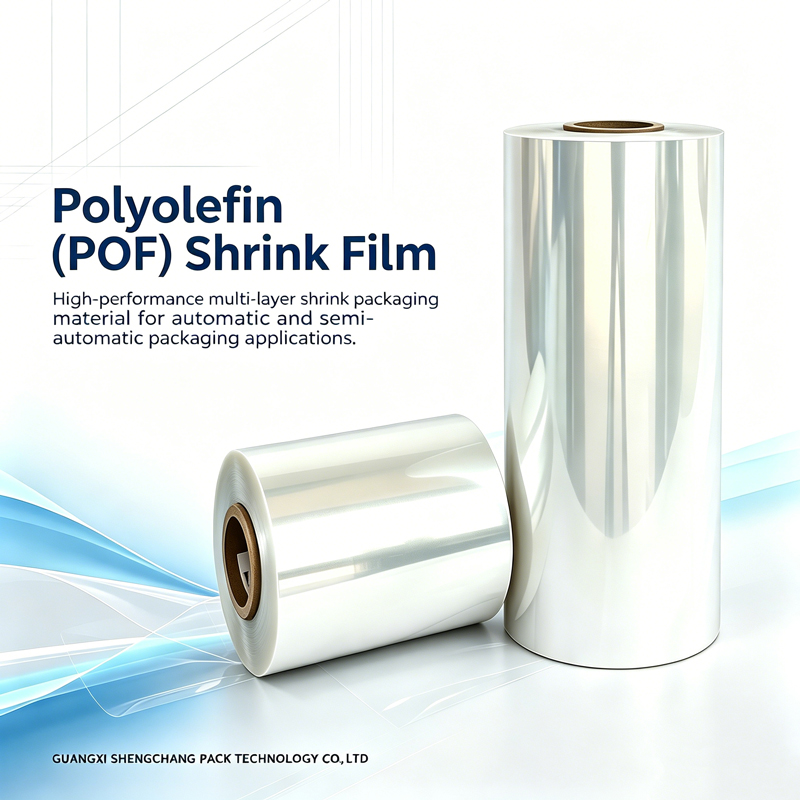



When using POF Shrink Film, achieving perfect packaging results depends on more than just selecting the right film.
Many packaging issues, such as loose shrinkage, wrinkles, poor appearance, or film damage, are related to incorrect shrink tunnel settings.
Unlike some packaging materials, POF Shrink Film does not require extremely high temperatures. Under normal conditions, most POF films achieve excellent shrink performance within a controlled temperature range.
This guide explains the recommended shrink temperature settings, key adjustment factors, and troubleshooting methods to help packaging users achieve stable and attractive results.
What Is the Recommended Shrink Temperature for POF Film?
For most standard POF Shrink Film applications, the recommended shrink tunnel temperature is generally:
115°C - 140°C
This range provides a good balance between:
Film shrink performance
Packaging appearance
Production efficiency
Product protection
However, the ideal temperature is not a fixed number. It should be adjusted according to the actual packaging conditions.
Factors That Affect POF Shrink Temperature Settings
1. Shrink Tunnel Design
The shrink tunnel is one of the most important factors affecting temperature requirements.
Different tunnels have different:
Heating systems
Air circulation designs
Fan power
Tunnel length
Temperature control accuracy
A high-efficiency shrink tunnel may achieve excellent results at lower temperatures, while another machine may require slightly higher settings.
2. Conveyor Speed
The relationship between temperature and conveyor speed is critical.
Faster conveyor speed:
Shorter heating time
May require slightly higher temperature
Slower conveyor speed:
Longer heating time
May allow lower temperature settings
The goal is to achieve complete shrinkage without overheating the film.
3. Film Thickness
Film thickness has some influence, but it is not the main factor determining shrink temperature.
For example:
10μm-15μm POF film usually shrinks easily under normal settings.
19μm-30μm thicker films may require slightly higher temperature or longer heating time depending on the application.
The correct adjustment should always be based on actual packaging results.
4. Product Size and Shape
Different products require different heat conditions.
Large or irregular products may need:
Higher airflow
Longer heating time
Proper tunnel adjustment
Small lightweight products usually shrink faster.
Recommended Starting Settings for POF Shrink Film
The following settings can be used as a starting reference:
| Item | Recommended Range |
|---|---|
| Shrink Tunnel Temperature | 115°C - 140°C |
| Film Type | POF Shrink Film |
| Heating Method | Hot Air Circulation |
| Adjustment Factors | Speed, Airflow, Product Size |
| Best Setting Method | Trial Adjustment |
Note: Actual settings should be optimized according to the specific shrink tunnel and packaging line.
How to Adjust Shrink Tunnel Temperature Correctly
Instead of setting the temperature too high immediately, we recommend adjusting gradually.
Step 1: Start With Medium Temperature
Begin around:
125°C - 130°C
and observe the shrink result.
Step 2: Check Packaging Appearance
A good shrink result should have:
Smooth surface
Tight packaging
No wrinkles
Clear appearance
Strong seal
Step 3: Adjust Temperature or Speed
If shrinkage is insufficient:
Increase slightly:
Temperature
Heating time
Airflow
If film shows:
Shrink holes
Excessive tension
Surface damage
Reduce:
Temperature
Heating time
Common POF Shrink Film Problems and Solutions
Problem 1: Film Does Not Shrink Completely
Possible Reasons:
Temperature too low
Conveyor speed too fast
Insufficient airflow
Solutions:
✔ Increase temperature slightly
✔ Reduce conveyor speed
✔ Check tunnel airflow
Problem 2: Wrinkles Appear After Shrinking
Possible Reasons:
Uneven heating
Incorrect tunnel airflow
Improper film selection
Solutions:
✔ Adjust airflow direction
✔ Optimize tunnel temperature
✔ Check film specification
Problem 3: Film Has Burn Marks or Holes
Possible Reasons:
Temperature too high
Heating time too long
Solutions:
✔ Reduce temperature
✔ Increase conveyor speed
Problem 4: Poor Sealing Performance
Possible Reasons:
Incorrect sealing settings
Sealing blade problems
Wrong film specification
Solutions:
✔ Check sealing temperature
✔ Maintain sealing system
✔ Confirm suitable POF film type
POF Shrink Film Temperature Tips for Different Applications
| Application | Recommended Starting Temperature |
|---|---|
| Cosmetics | 120°C - 130°C |
| Bakery Products | 120°C - 135°C |
| Food Packaging | 120°C - 135°C |
| Books & Stationery | 125°C - 140°C |
| Beverage Multipacks | 130°C - 140°C |
| Heavy Products | 130°C - 140°C |
(Final settings depend on machine conditions.)
Why High-Quality POF Film Requires Less Adjustment
A stable POF Shrink Film should provide:
Uniform thickness
Consistent shrink performance
Stable sealing
Excellent clarity
Reliable machine running
Poor-quality film may cause:
Uneven shrinkage
Frequent machine adjustments
Higher packaging waste
Choosing a reliable POF manufacturer helps maintain stable production efficiency.
Conclusion
The correct POF Shrink Film shrink temperature depends on many factors, including shrink tunnel design, conveyor speed, airflow, product size, and film specifications.
In most applications, POF Shrink Film performs well within a temperature range of 115°C-140°C.
Instead of using a fixed temperature setting, packaging operators should adjust the shrink tunnel based on actual packaging results to achieve the best balance between shrink quality, production speed, and energy efficiency.
FAQ
What is the best temperature for POF shrink film?
Most POF Shrink Films work well between 115°C and 140°C, depending on the shrink tunnel and packaging conditions.
Does thicker POF film need higher temperature?
Not necessarily. Thickness has some influence, but machine conditions and airflow usually have a greater impact. Thicker films may require slight adjustment when needed.
Why does my POF film have wrinkles after shrinking?
Common reasons include improper temperature, incorrect conveyor speed, or uneven hot air circulation.
Can POF shrink film shrink at low temperatures?
Yes. Compared with some traditional shrink films, POF can achieve excellent shrink performance at relatively low temperatures.